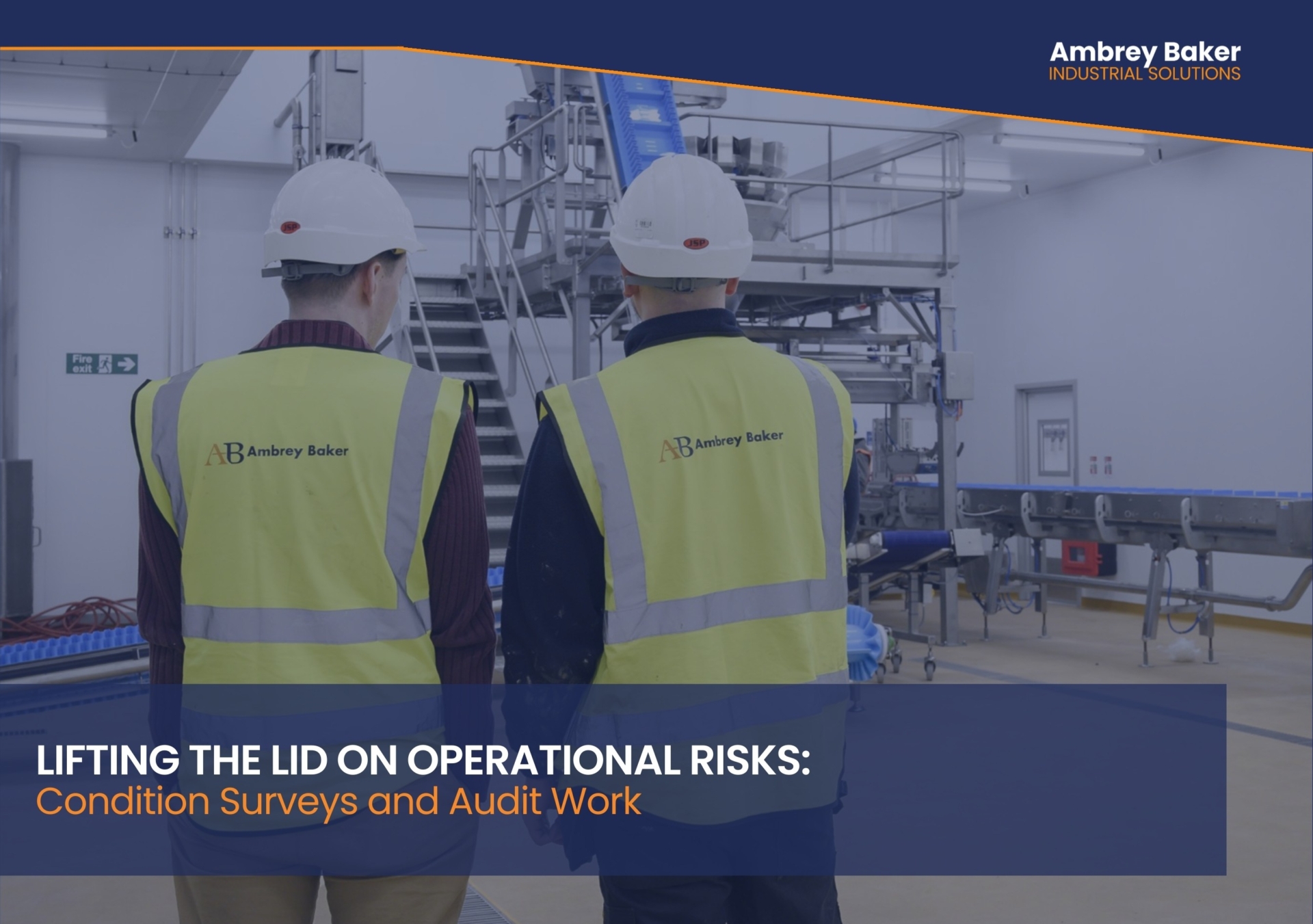
Lifting the Lid on Operational Risks: Condition Surveys and Audit Work
In the industrial and food manufacturing world, resilience has become as important as efficiency. Businesses today are navigating rising compliance demands, tighter insurance scrutiny, and increasing pressure to extend the life of facilities and assets while keeping downtime to a minimum. Yet many of the most serious risks are invisible until it is too late. Deterioration often hides within the fabric of a building, behind panels, or in machinery that appears to be working until a sudden failure occurs. Condition surveys and audit work are vital because they lift the lid on these risks before they turn into costly realities.
The true value of a condition survey lies not in cataloguing faults but in providing leaders with evidence to guide strategic decisions. Instead of relying on assumptions about how long a roof will last or whether refrigeration units can sustain another cycle, organisations gain an accurate record of the condition of their estate. This turns guesswork into foresight, making it possible to plan investment, direct maintenance budgets, and identify assets suitable for repurposing or decommissioning. The UK Government’s Building Safety Act 2022 underscores the importance of structured inspections and reliable reporting as a foundation for compliance, reinforcing that these surveys are more than technical exercises; they are now integral to long-term asset strategy.
The implications extend well beyond compliance alone. Condition surveys support the ability to meet insurer requirements and satisfy regulators who demand demonstrable evidence that workplaces are safe and well maintained. Insurers increasingly look for detailed integrity reports before underwriting complex industrial faciliti es. Regulators expect records that prove statutory safety standards are being met. In both cases, a systematic survey reduces uncertainty and protects organisations not only from operational failures but also from reputational damage and financial penalties. For businesses working in sectors where one compliance lapse can threaten contracts or market access, this assurance is invaluable.
Audit work at an early stage of a project is equally important in preventing expensive surprises. When organisations are planning relocations, consolidations, or major upgrades, the risks of hidden weaknesses surfacing mid-programme are high. Electrical systems can turn out to be non-compliant, plant equipment may be nearing the end of its life, or structural concerns might only come to light once work has begun. Any of these discoveries can derail budgets and schedules. The Infrastructure and Projects Authority has highlighted that robust front-end assessments are among the most effective tools to reduce project overruns across the UK, and condition surveys are central to that assurance. A modest investment at the outset saves far larger sums later by ensuring projects are grounded in a true understanding of asset condition.
In the food industry, the stakes are even higher. Cold storage facilities, hygiene-critical environments, and process-intensive production lines all present risks that general surveys may miss. Condensation damage, thermal bridging, microbial contamination, and accelerated wear on refrigeration plant can all undermine safety and reliability if left unchecked. The Food Standards Agency’s food hygiene guidance makes clear that compliance depends not just on processes but on the condition of facilities themselves. For food businesses, where the ability to meet hygiene requirements is directly tied to maintaining contracts with retailers or food service operators, detailed condition surveys offer both risk reduction and commercial protection.
Condition surveys also provide a baseline for predictive maintenance and lifecycle planning. With accurate data, facilities teams can anticipate when asset
s should be repaired, replaced, or retired, scheduling interventions before failures occur. In times of site consolidation, the same data informs decisions about what to relocate, what to sell, and what to decommission. By combining technical accuracy with strategic foresight, surveys turn static records into powerful planning tools.What emerges from this is a culture of resilience. Too often, organisations treat surveys as one-off exercises, conducted only when an issue is suspected. Their real impact comes when they are embedded into a continuous programme of audit and review, where risks are monitored and mitigated on an ongoing basis. This approach not only prevents sudden breakdowns but also supports broader organisational goals, from sustainability and energy efficiency to compliance with tightening carbon reporting standards. Accurate condition data makes it possible to identify opportunities to cut emissions, improve performance, and demonstrate compliance with confidence.
Ultimately, condition surveys and audit work are diagnostic tools with strategic impact. They allow businesses to uncover what cannot be seen, quantify risks that might otherwise be missed, and act before problems escalate. They reassure insurers, satisfy regulators, and give leadership teams the clarity they need to invest wisely. In an era where supply chains are under strain and regulatory expectations continue to rise, these insights are no longer a luxury but a necessity. By shining a light on hidden risks, surveys transform uncertainty into operational advantage.
RESOLVE COMPLEX INDUSTRIAL DESIGN OR CONSTRUCTION CHALLENGES WITH CONFIDENCE.
For a no obligation initial consultation with one of the UK’s leading industrial construction and technical advisory experts, contact us today to gain clear, practical guidance on critical technical, engineering, and construction issues.
Paul Waldeck BEng(Hons), CEng., MICE., MIStruct.E, MIMech.E., MASHRAE
paul.waldeck@ambreybaker.co.uk